
AI Reading
Quick summary of this article
This guide provides a complete syllabus for learning the BLoC (Business Logic Component) pattern in Flutter, a powerful state management solution for building scalable apps. It covers everything from basic state management concepts to advanced techniques and real-world projects, helping developers write clean, testable, and maintainable code.
- The syllabus starts with an introduction to state management in Flutter, comparing BLoC to other solutions like setState, Provider, and Riverpod.
- Core topics include understanding events and states, using Cubit for simpler cases, and building event-driven BLoC classes for complex logic.
- Key widgets like BlocProvider, BlocBuilder, BlocListener, and BlocConsumer are explained for connecting BLoC to the user interface.
- Advanced concepts cover Hydrated BLoC for state persistence, event transformers, error handling, and writing unit and widget tests.
- The syllabus recommends real-world projects such as a login system and CRUD applications, along with best practices like clean architecture and dependency injection.
🧑💻 Introduction
As Flutter continues to grow in popularity, managing app state efficiently becomes crucial for building scalable and maintainable applications. One of the most powerful and widely adopted solutions for state management in Flutter is the BLoC (Business Logic Component) Pattern.
Whether you’re just starting with Flutter or looking to level up your development skills, learning BLoC will give you a deeper understanding of reactive programming and help you build clean, testable, and maintainable apps.
This blog post presents a complete Flutter BLoC syllabus, carefully structured into topics and subtopics — from the basics of state management to advanced concepts and real-world implementations.
🧠 Flutter BLoC Syllabus
1. Introduction to State Management
- What is State Management?
- Why State Management is important in Flutter?
- Common solutions in Flutter:
- setState
- Provider
- Riverpod
- Redux
- BLoC / Cubit
2. Getting Started with BLoC
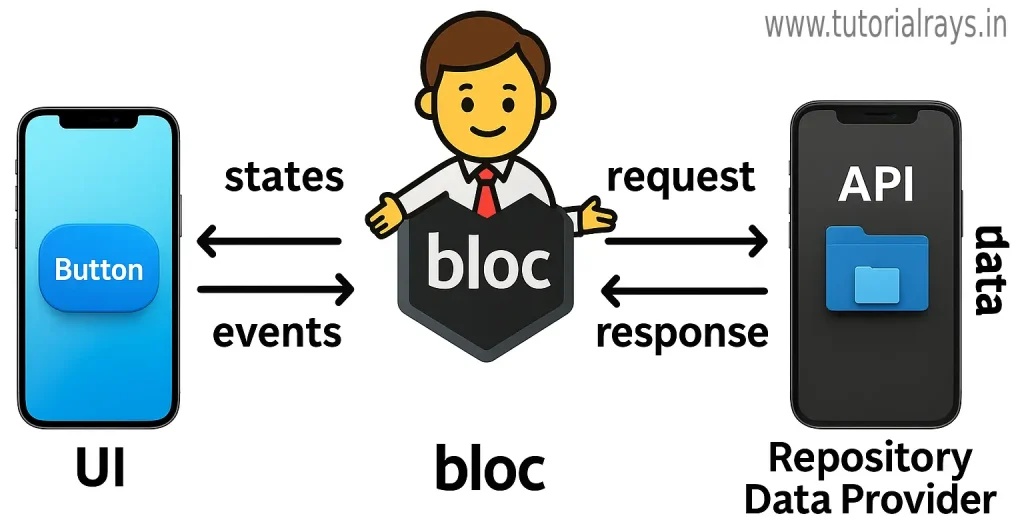
- What is the BLoC Pattern?
- How BLoC works (Streams, Sinks)
- Differences: BLoC vs Cubit
- Installing
flutter_blocandblocpackages
3. Core Concepts
- Events and States
- BLoC Class vs Cubit Class
- BlocProvider, BlocBuilder, BlocListener, BlocConsumer
4. Working with Cubit (Simplified BLoC)
- Creating a Cubit
- Emitting simple states (e.g., Counter App)
- UI connection using
BlocBuilder&BlocProvider
5. Working with BLoC (Event-Based)
- Defining Events and States
- Writing a BLoC Class
- Handling events with
on<Event>() - Emitting states using
emit()
6. BlocProvider & MultiBlocProvider
- Understanding widget-level BLoC scope
- Passing BLoC to child widgets
- Combining multiple BLoCs
7. BlocBuilder, BlocListener, BlocConsumer
- Rebuilding UI with BlocBuilder
- Responding to state changes using BlocListener
- Combining logic & UI with BlocConsumer
8. Advanced BLoC Concepts
- Using Hydrated BLoC (Persistence)
- Event Transformers (Debounce, SwitchMap, etc.)
- Error Handling in BLoC
- Writing Unit & Widget Tests
9. Real-World Projects Using BLoC
10. Best Practices & Architecture
- Clean Architecture with BLoC
- Folder Structure & Code Organization
- Layered Approach: Presentation / Domain / Data
- Using BlocObserver for Global State Tracking
- Integrating Dependency Injection (get_it, injectable)
✅ Summary
Flutter BLoC is a robust and scalable solution for managing state in Flutter applications. This syllabus offers a step-by-step guide from basic concepts to advanced patterns and real-world projects. By mastering BLoC, you’ll write cleaner, more modular code and create maintainable applications with ease.
Whether you’re a beginner or an experienced developer, this roadmap will serve as a foundation for implementing scalable state management in your Flutter projects.