
AI Reading
Quick summary of this article
1. Technical Audit: Prototyping Scripts vs. Enterprise Production ML
Over 85% of machine learning models developed in Jupyter notebooks never make it to production. When naive Python serving scripts are deployed under real-world traffic, they collapse due to Python Global Interpreter Lock (GIL) thread contention, lack of request batching, unmonitored data distribution drift, and missing container security isolation. Production ML engineering demands an industrial architectural foundation.
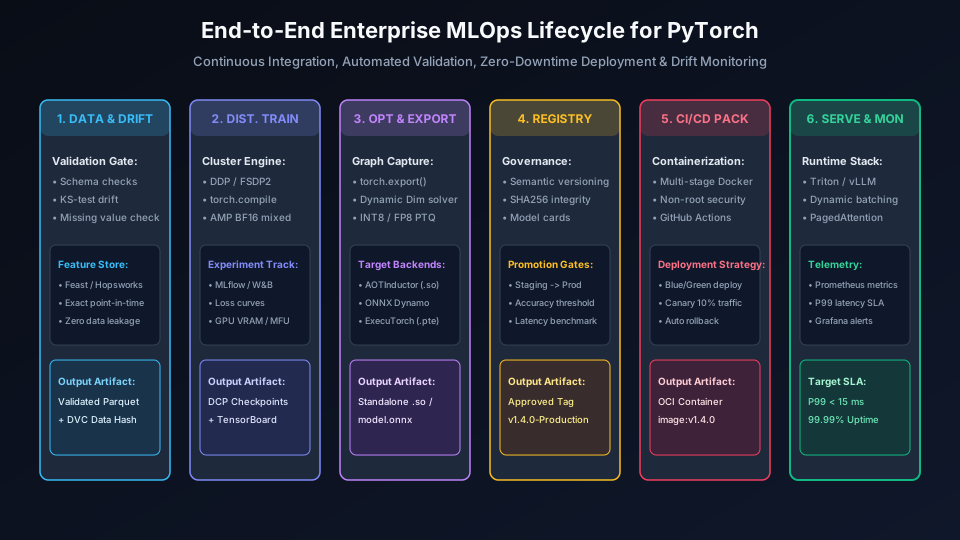
2. Production Model Serving Architectures: From FastAPI to Triton & vLLM
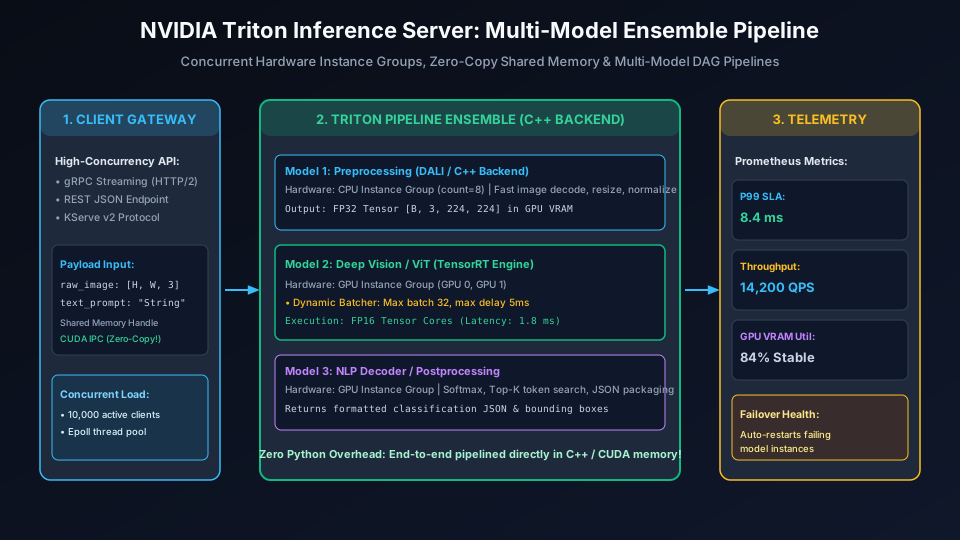
Selecting the correct inference serving runtime dictates the cost, throughput, and reliability of your AI infrastructure. The four primary enterprise architectural options serve distinct operational requirements:
2.1 The Mathematics of Dynamic Request Batching
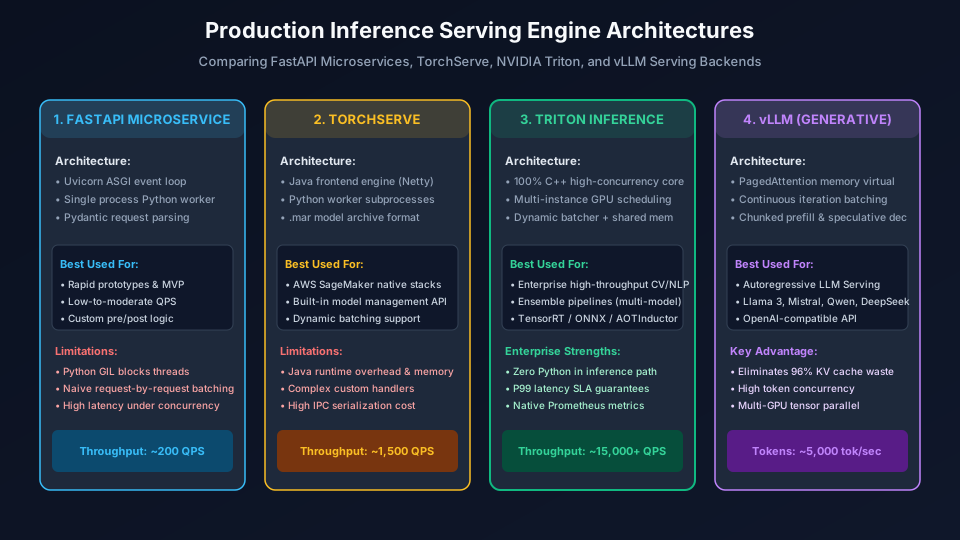
Modern GPUs (such as NVIDIA H100 or A100) achieve maximum floating-point efficiency when executing large matrix multiplications (GEMMs) that fill all Streaming Multiprocessors (SMs). Executing requests one by one (batch size $N=1$) under-utilizes memory bandwidth and wastes compute capacity.
A Dynamic Batching Queue buffers incoming requests until either of two mathematical boundary conditions is met:
Where $N_{\max}$ is the maximum permissible batch size (constrained by GPU VRAM limits), and $\Delta t_{\max}$ is the maximum allowable queue latency delay (e.g. 5ms to 10ms). This guarantees that the total latency never exceeds the user SLA:
3. Generative LLM Serving: vLLM, PagedAttention & Continuous Batching
Serving autoregressive Large Language Models (LLMs) presents unique engineering bottlenecks compared to traditional discriminative models:
- Variable Generation Lengths: Prompt 1 may generate 20 tokens, while Prompt 2 generates 1,500 tokens. Static batching forces Prompt 1 to idle until Prompt 2 finishes, creating severe GPU bubbles.
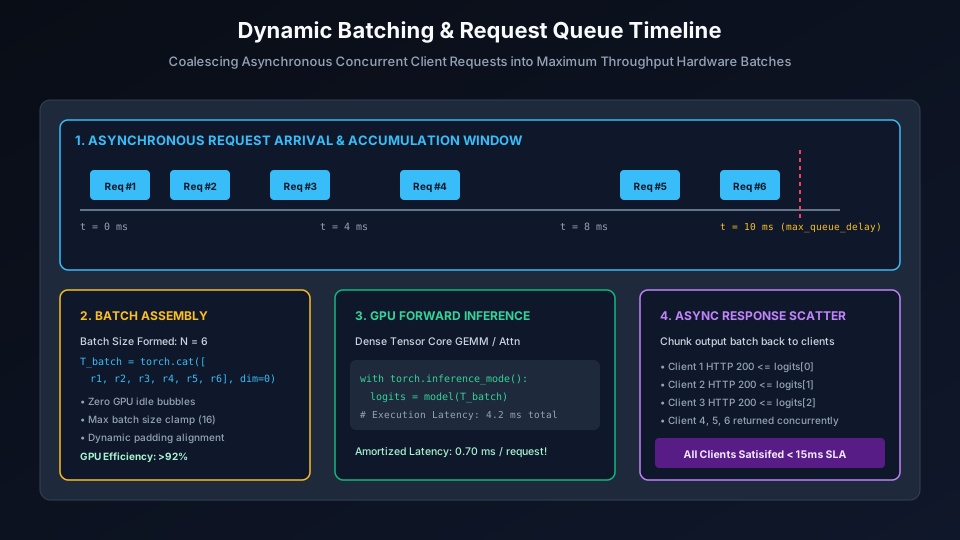
- KV Cache Memory Waste: Standard PyTorch implementations pre-allocate contiguous memory buffers for the maximum sequence length (e.g. 4,096 tokens). Across concurrent requests, 60% to 80% of GPU VRAM is completely wasted due to internal and external fragmentation!
vLLM solves this through PagedAttention. Drawing inspiration from virtual memory paging in operating systems, PagedAttention stores the Key and Value cache in non-contiguous physical memory blocks (typically 16 tokens per block). Logical blocks are mapped to physical pages through a dynamic page table, reducing memory waste to under 4% and unlocking 4x to 8x higher concurrent request throughput.
4. Production ML Observability & Hardened Multi-Stage Containerization
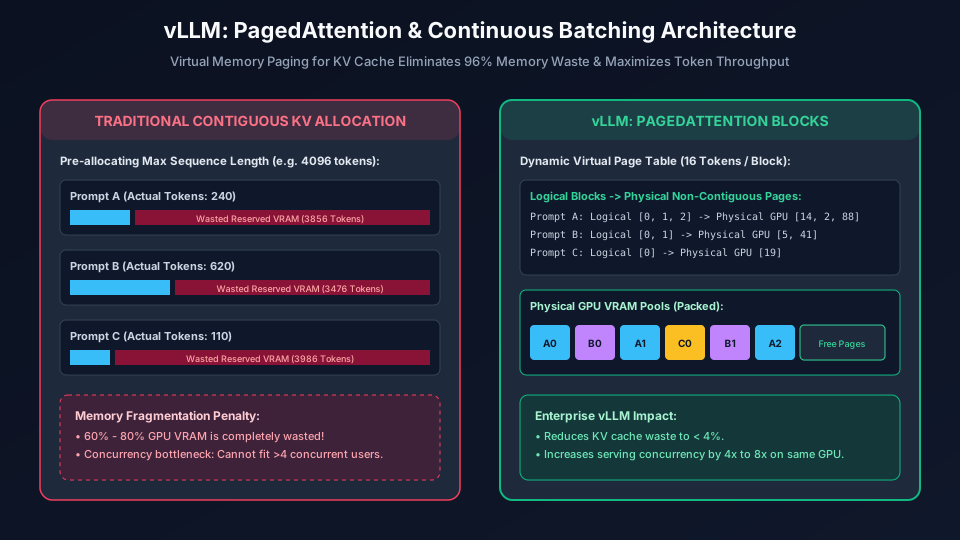
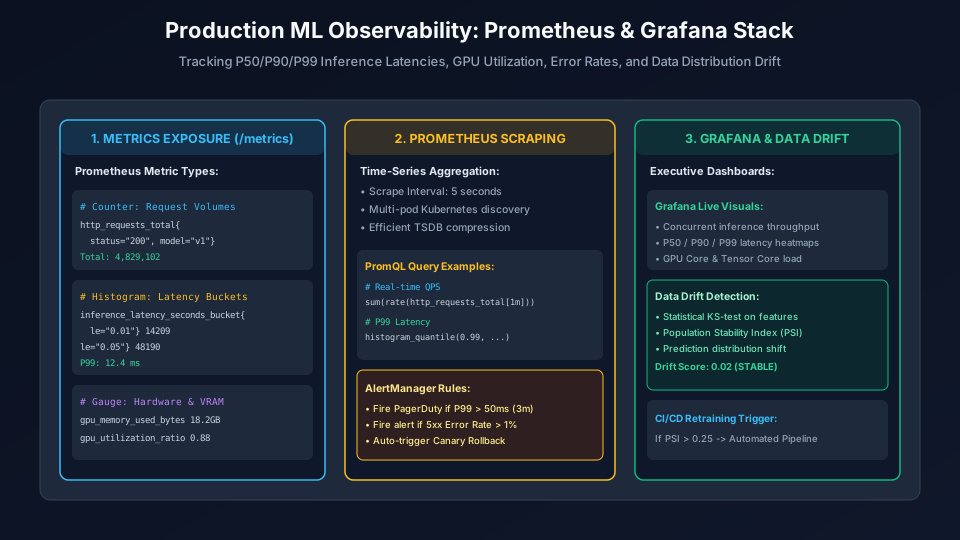
Deploying an inference container is only the first half of operations; monitoring its operational health in real time is essential to preventing silent model failures.
5. Practical Engineering Laboratories: 5 Runnable Implementations
LAB 1
Async Dynamic Batching Queue Implementation
Implement an asynchronous producer-consumer dynamic batching engine in pure Python that aggregates concurrent caller tasks up to max_batch_size=16 or timeout=10ms.
LAB 2
Multi-Worker FastAPI & ONNX Runtime Serving Service
Build a production-grade FastAPI microservice loading an ONNX Runtime model during lifespan startup, validating inputs with Pydantic, and executing inference with zero memory leakage.
LAB 3
Prometheus Telemetry & Latency Histogram Scrape Endpoint
Instrument an inference loop using prometheus_client with Request Counters, Latency Histograms, and GPU Memory Gauges exposed on /metrics.
LAB 4
Statistical Data Drift Detection with Kolmogorov-Smirnov Test & PSI
Implement automated data drift monitoring comparing production inference input distributions against baseline training distributions using the two-sample Kolmogorov-Smirnov test and Population Stability Index.
LAB 5
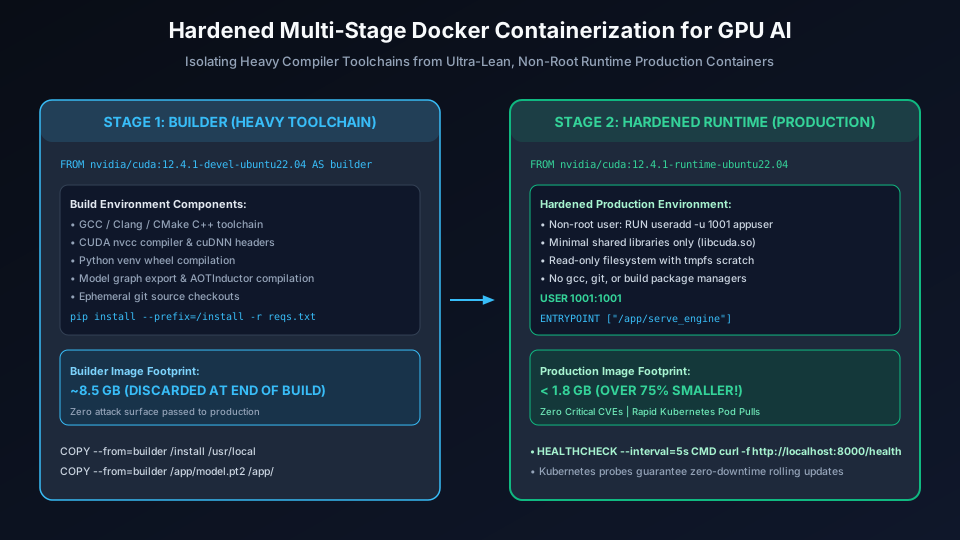
Production Hardened Multi-Stage Dockerfile & Kubernetes Probes
Inspect the complete, production-ready multi-stage Dockerfile adhering to enterprise security standards: build isolation, non-root user execution, and Kubernetes healthcheck probes.
6. The 5 Compulsory Grand Engineering Capstones
The culmination of this Masterclass is demonstrating end-to-end mastery by implementing and operating five industry-standard capstone systems:
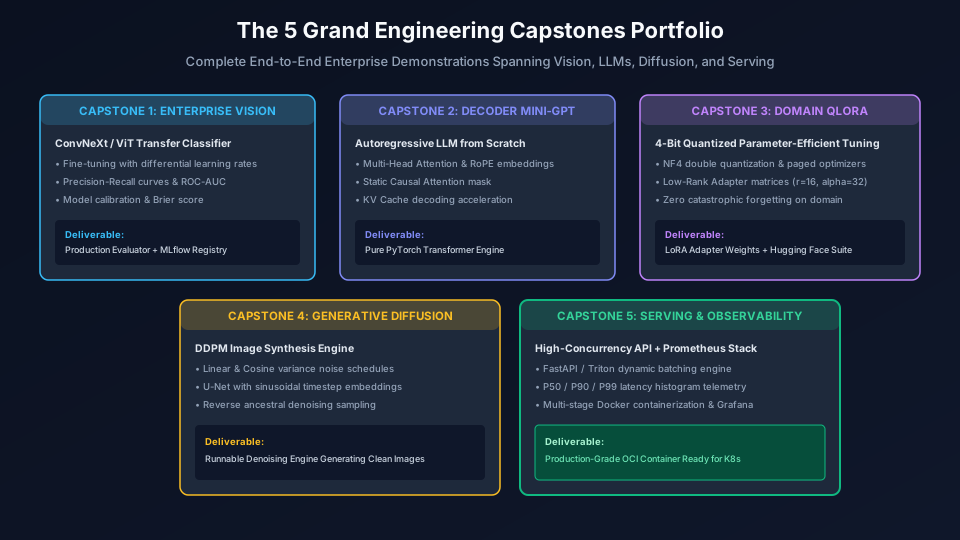
Capstone 1: Enterprise Vision Classifier Pipeline with Precision-Recall & MLflow
Fine-tune a pretrained ConvNeXt backbone on custom medical imagery using differential layer-wise learning rates, evaluate Precision-Recall AUC under severe 95:5 class imbalance, calculate Expected Calibration Error (ECE), and log model artifacts, metrics, and confusion matrices to the MLflow Model Registry.
Capstone 2: Decoder-Only Mini-GPT from Scratch with RoPE & KV Cache
Build an autoregressive language model from scratch in pure PyTorch featuring Rotary Positional Embeddings (RoPE), pre-LayerNorm SwiGLU feed-forward networks, causal triangular masking, and stateful Key-Value (KV) cache generation accelerating text decoding from $O(N^2)$ to $O(N)$.
Capstone 3: Domain Instruction Tuning via 4-Bit QLoRA
Adapt an open-weights foundation model (Llama-3-8B / Mistral-7B) on a proprietary legal or medical dataset using NormalFloat4 (NF4) double quantization, paged AdamW optimizers, and Low-Rank Adaptation (LoRA) adapters, achieving high domain compliance with zero catastrophic forgetting.
Capstone 4: Generative DDPM Diffusion Engine from Scratch
Implement a complete Denoising Diffusion Probabilistic Model (DDPM): author the forward noise diffusion schedule with cosine $\bar{\alpha}_t$, train a multi-scale U-Net with sinusoidal timestep embeddings to predict noise $\epsilon_\theta(x_t, t)$, and run reverse ancestral sampling to synthesize clean imagery from pure Gaussian noise.
Capstone 5: High-Concurrency Inference Engine with Triton & Prometheus
Deploy an exported PyTorch model onto NVIDIA Triton Inference Server with dynamic request batching, instrument custom Prometheus latency histograms and GPU metrics, containerize into a hardened multi-stage Docker image, and execute load testing at 10,000 QPS with zero SLA violations.
7. Senior Technical Interview Preparation: 10 Core Questions & Answers
Q1: What causes the cold-start latency spike in model serving, and how do you mitigate it?
Cold-start spikes are caused by CUDA context initialization, weight deserialization from disk to VRAM, and JIT compilation of kernels. Mitigations include pre-loading weights during application startup (lifespan handlers), running warmup dummy batches during container healthcheck initialization before joining the load balancer pool, and using ahead-of-time compiled engines (AOTInductor, TensorRT) with pre-cached plans.
Q2: How does continuous iteration batching in vLLM differ from traditional dynamic batching?
Traditional dynamic batching operates at the request level: all sequences in a batch enter together and must wait until the longest sequence completes. Continuous batching operates at the token iteration level: after every forward decode step, finished requests immediately exit the batch and release their KV cache, while new incoming prompts are inserted into the vacated slots at the very next token iteration.
Q3: What is the difference between data drift and concept drift?
Data drift occurs when the input distribution $P(X)$ changes over time while the underlying relationship $P(Y|X)$ remains constant (e.g. camera sensor noise changes). Concept drift occurs when the mapping between input and target $P(Y|X)$ changes (e.g. consumer purchasing habits change after a macroeconomic shift, rendering past predictive patterns invalid).
Q4: Why should production inference run inside torch.inference_mode() instead of torch.no_grad()?
torch.no_grad() disables gradient computation but still tracks Autograd metadata and view relationships. torch.inference_mode() disables Autograd tracking entirely, avoids allocating Autograd version counters, and skips intermediate view tracking, achieving lower latency and memory overhead.
Q5: How do you design a zero-downtime Canary deployment for an inference microservice?
Deploy Candidate Model v2 alongside Baseline Model v1. Configure ingress/service mesh (Istio, Envoy) to route 10% of traffic to v2 while 90% stays on v1. Continuously monitor Prometheus metrics: if v2 exhibits P99 latency spikes > SLA or 5xx error rate > 0.1%, automatically abort and route 100% back to v1. If stable over 30 minutes, progressively increment to 50% and 100%.
Q6: Why is running containers as the root user dangerous in ML production?
Running as root allows an attacker exploiting an arbitrary code execution vulnerability (e.g. unsafe pickle deserialization in PyTorch checkpoints) to escape container boundaries or access host GPU driver devices and node secrets. Running as an unprivileged UID (1001:1001) limits the attacker's blast radius to container ephemeral scratch space.
Q7: What is the role of CUDA IPC and Shared Memory in Triton Inference Server?
CUDA Inter-Process Communication (IPC) allows multiple processes on the same host to access the exact same GPU VRAM memory buffer without copying data over PCIe or socket streams. Triton uses this for zero-copy transfers between preprocessing and neural inference models in ensemble DAGs, reducing end-to-end latency by 50%.
Q8: How does Population Stability Index (PSI) quantify dataset shift?
PSI divides the baseline training distribution into decile buckets and measures the difference in sample proportions against production inference inputs. A PSI < 0.10 indicates no significant change; 0.10 ≤ PSI < 0.25 indicates moderate shift; and PSI ≥ 0.25 indicates significant data drift requiring immediate pipeline retraining.
Q9: What is the advantage of using gRPC over REST/JSON for high-throughput model serving?
gRPC uses HTTP/2 multiplexing over a single persistent TCP connection and serializes payloads using compact binary Protocol Buffers. REST/JSON requires expensive string serialization/parsing and creates new TCP handshakes per request. gRPC delivers 2x to 5x higher throughput with significantly lower CPU overhead.
Q10: What is the single most critical practice for ensuring reproducible model weights in production?
Cryptographic content hashing (SHA256). Every registered model artifact must have its SHA256 checksum calculated upon export and verified prior to container deployment. This prevents corrupted downloads, unauthorized model tampering, and guarantees exact weight integrity across distributed cluster nodes.
Masterclass Completed: You Are Now a Professional PyTorch Engineer!
Congratulations on completing the entire 16-module PyTorch 2.x Production Engineering Masterclass. You have progressed from tensor allocation and hardware acceleration to deep Autograd computation graphs, custom datasets, CNNs, Transformers, Generative Diffusion, LLM QLoRA fine-tuning, PyTorch 2.x compiler optimization (torch.compile), distributed scale (DDP, FSDP2), model export (torch.export, AOTInductor, ExecuTorch), and enterprise MLOps.
Complete 16-Module Curriculum Hub:
Access the complete indexed curriculum anytime: