
AI Reading
Quick summary of this article
1. Technical Audit: Legacy TorchScript vs. Modern PyTorch 2.x Export Ecosystem
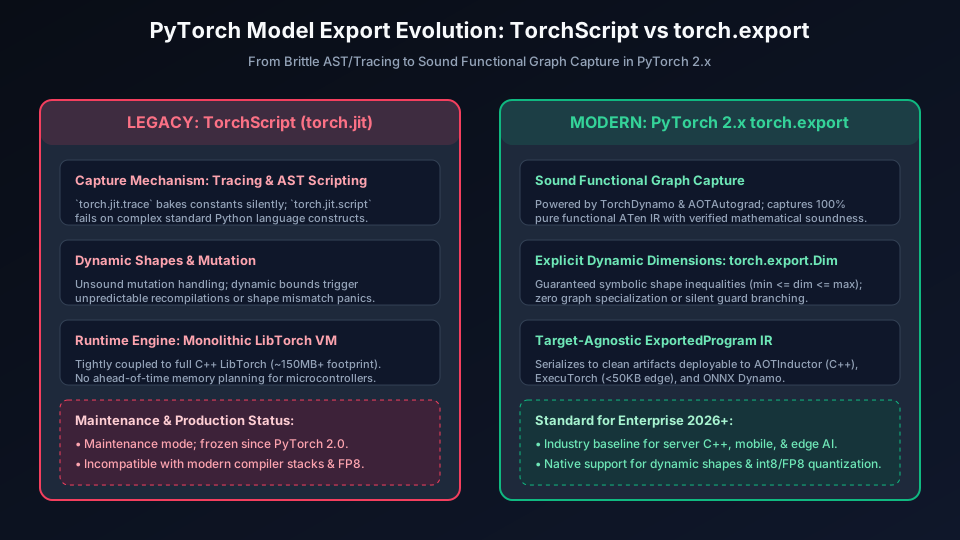
For nearly a decade, machine learning engineers deployed PyTorch models using TorchScript (torch.jit.trace and torch.jit.script). While revolutionary for its era, TorchScript relied on brittle Python AST parsing and tracing mechanisms that silently baked dynamic shapes into constants, failed abruptly on Pythonic dictionary and tuple control-flow, and mandated shipping the massive, monolithic LibTorch C++ runtime (~150MB+ binary footprint). PyTorch 2.x introduces a ground-up reimagination: torch.export, coupled with backend-specific Ahead-of-Time compilers.
2. Formal Graph Capture Semantics: TorchDynamo, Functionalization & Dynamic Shapes
In production engineering, a model export is only as reliable as its mathematical soundness. PyTorch’s eager mode allows dynamic Python control flow, global variable mutation, and tensor in-place operations (x.add_(1)). While convenient during research, such operations make it impossible to lower a computation graph to static C++ kernels or hardware accelerators without sound transformations.
2.1 The Soundness Contract of torch.export
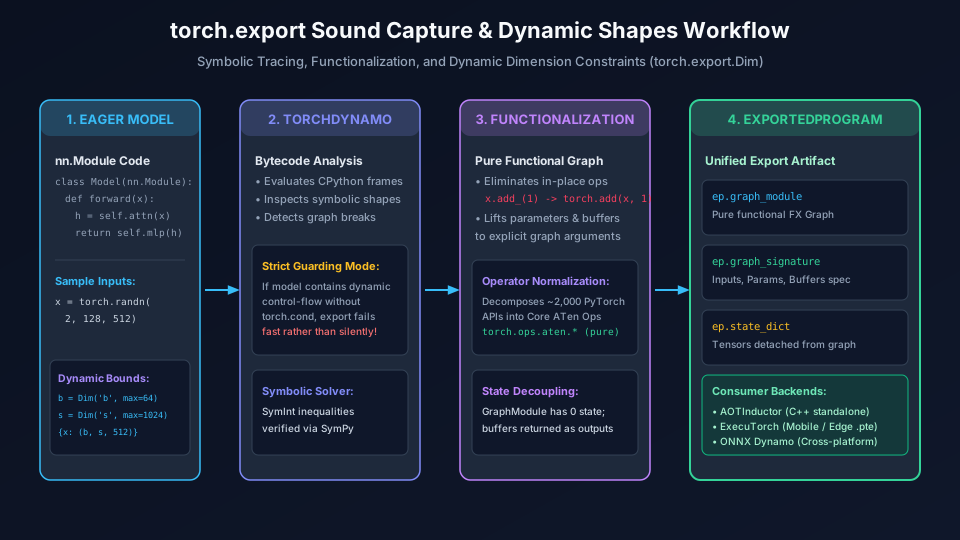
When calling torch.export.export(model, args, dynamic_shapes=...), the PyTorch compiler pipeline executes four rigorous phases:
-
Bytecode Analysis via TorchDynamo: Evaluates standard CPython execution frames, transforming Python instructions into an intermediate FX graph while maintaining formal guards. Unlike
torch.compile, which falls back to eager execution upon encountering a graph break,torch.exportruns in strict mode by default: any Python branch that cannot be soundly captured as a graph operator raises an immediate compilation error. -
Functionalization via AOTAutograd: In-place tensor mutations are systematically transformed into out-of-place functional operations:
y = x.add_(5.0) ⟶ y = torch.ops.aten.add(x, 5.0)
Parameters and persistent buffers are decoupled from object attributes and lifted to explicit positional input arguments.
-
Core ATen Operator Decomposition: Decomposes over 2,000 public PyTorch high-level APIs into a tiny, rigorously standardized set of ~180 Core ATen Operators (
torch.ops.aten.*). This ensures that downstream backends (such as AOTInductor, ONNX, and ExecuTorch) only need to support the Core ATen subset. -
Symbolic Dynamic Dimension Solver: Uses SymPy to construct formal inequality bounds for every variable dimension. If an engineer specifies a dynamic batch dimension
Dim('batch', min=1, max=64), the exporter proves symbolically that the tensor shape satisfies the mathematical contract across all downstream operators.
2.2 Inside the ExportedProgram IR
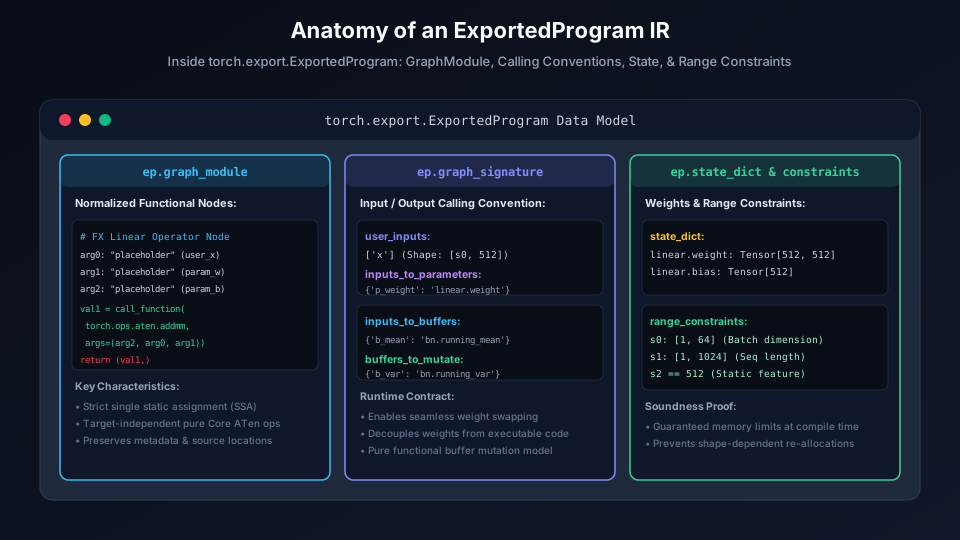
The object returned by torch.export.export() is an instance of torch.export.ExportedProgram. This object completely encapsulates the computation graph and its calling convention:
3. AOTInductor: Python-Free C++ Shared Library Deployment
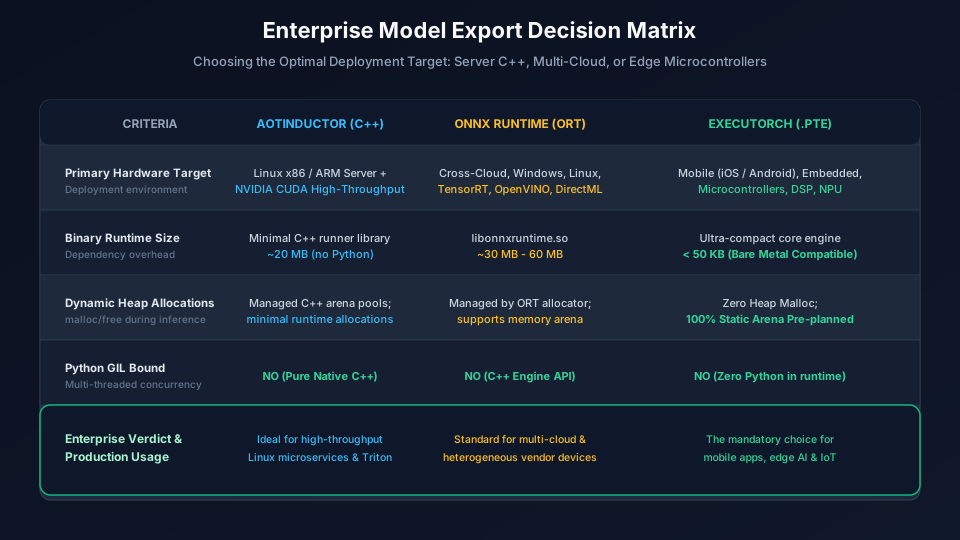
For latency-critical production environments (such as high-frequency trading, real-time robotics, and autonomous driving), hosting models inside a Python server process incurs substantial penalties:
- The Global Interpreter Lock (GIL): Restricts concurrent multi-threaded inference across multi-core CPUs.
- Garbage Collection Pauses: CPython cyclic garbage collection causes unpredictable P99 and P99.9 latency spikes.
- Memory Overhead: Full Python runtime and PyTorch wheels occupy hundreds of megabytes of memory per worker process.
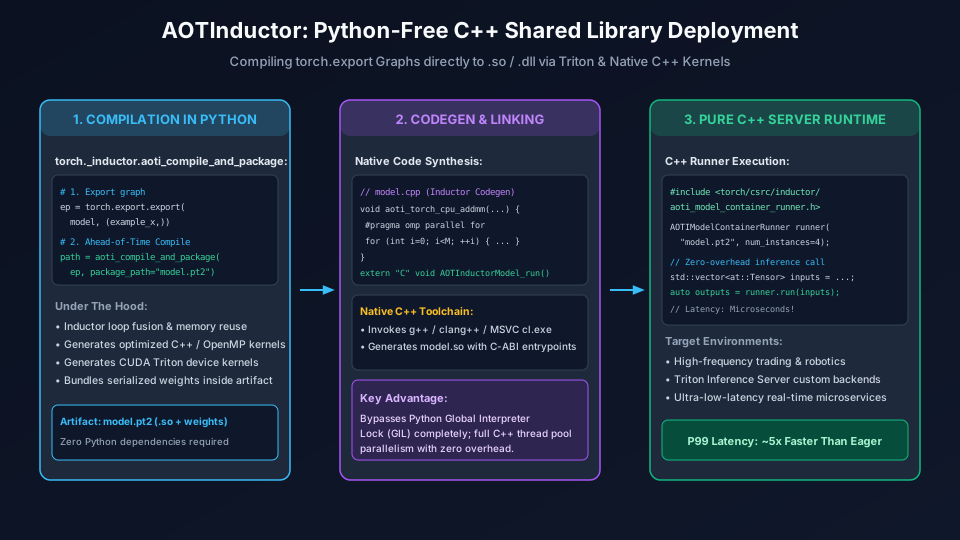
AOTInductor (Ahead-of-Time Inductor) is PyTorch’s native compiler solution. It takes an ExportedProgram, applies Inductor’s loop-fusion and memory reuse optimizations, generates raw C++ / OpenMP kernels for CPU and Triton kernels for CUDA, invokes the system C++ compiler (g++, clang++, or MSVC cl.exe), and outputs a self-contained shared library (model.so / model.pt2).
4. Modern ONNX Dynamo Exporter & ONNX Runtime Execution Providers
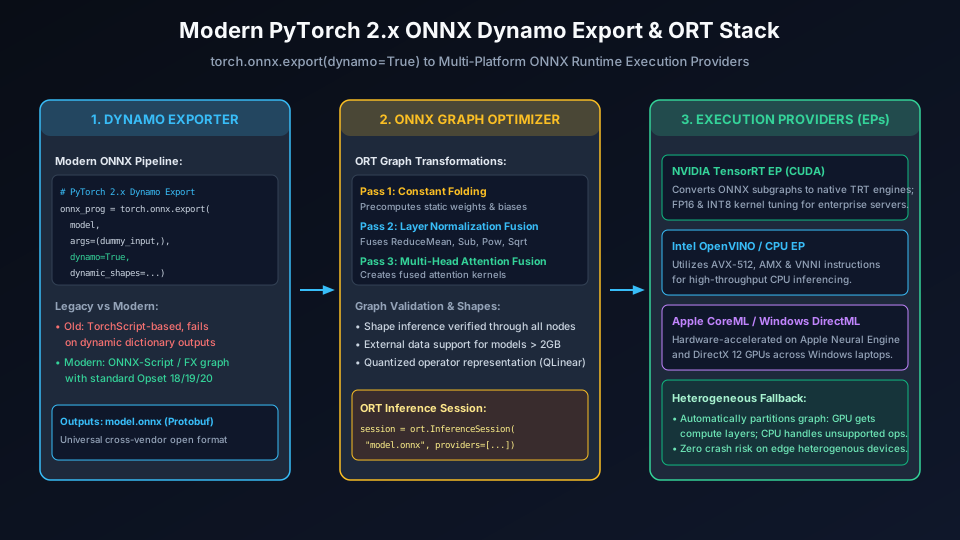
The Open Neural Network Exchange (ONNX) remains the enterprise industry standard for cross-platform model interchange. In PyTorch 2.x, the ONNX exporter was completely rewritten to utilize TorchDynamo and ONNX-Script:
onnx_program = torch.onnx.export(
model,
args=(dummy_input,),
dynamo=True, # Enables pure FX graph conversion
dynamic_shapes={“input”: {0: “batch_size”, 1: “seq_len”}},
opset_version=18
)
onnx_program.save(“model.onnx”)
Once exported to ONNX ModelProto format, models are deployed via ONNX Runtime (ORT). The core strength of ORT lies in its Execution Providers (EPs): the runtime automatically partitions the computation graph, offloading heavy matrix multiplications to NVIDIA TensorRT or CUDA, running attention and normalization layers on DirectML or CoreML, and falling back gracefully to optimized Intel OpenVINO / CPU for unsupported operators.
5. ExecuTorch: Zero-Allocation On-Device AI for Mobile & Microcontrollers
Deploying neural networks on edge devices (iOS iPhones, Android smartphones, AR glasses, embedded robotics, and microcontrollers) presents severe resource constraints:
- Strict Memory Bounds: Microcontrollers may have as little as 512KB of SRAM. Dynamic heap allocations (
malloc()) lead to memory fragmentation and unrecoverable Out-Of-Memory (OOM) crashes. - Binary Footprint Limits: LibTorch is 150MB+; mobile app binary budgets often allow only a few megabytes for AI models.
- Specialized Accelerators: NPUs (Apple Neural Engine, Qualcomm Hexagon DSP, MediaTek NeuroPilot) require specialized delegate lowering.
ExecuTorch is PyTorch’s official next-generation edge deployment runtime. It takes an ExportedProgram and lowers it to the Edge Dialect (EXIR). ExecuTorch performs Ahead-of-Time Memory Planning: using liveness analysis, it calculates the exact memory lifespan of every intermediate activation tensor and merges non-overlapping lifespans into a single, compact, static memory arena. At inference time, ExecuTorch makes zero calls to malloc()! The serialized binary (.pte FlatBuffer) can even be memory-mapped (mmap) directly from flash storage without consuming system RAM.

6. Quantization for Export: Mathematical Formulations of PTQ & QAT
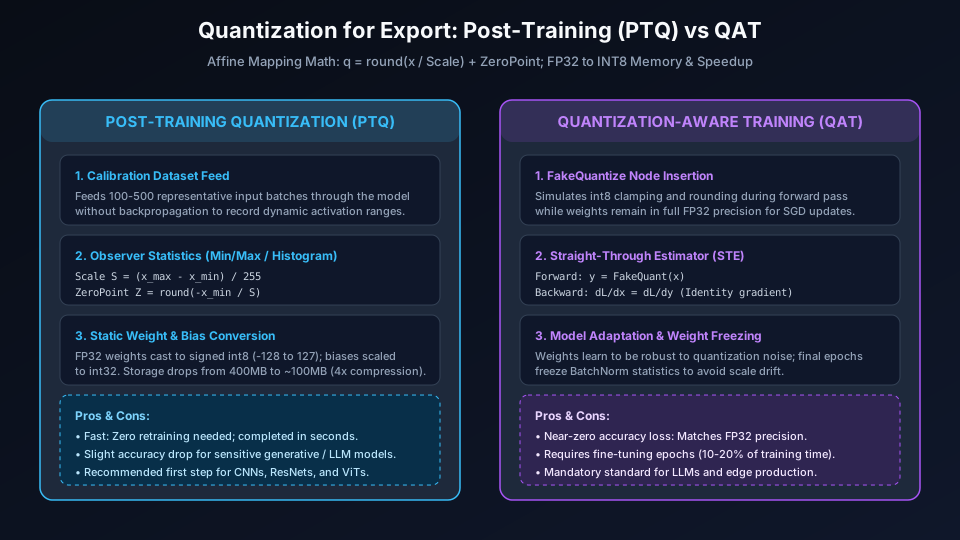
Exporting models to edge devices or high-throughput servers almost always involves precision downcasting from 32-bit floating point (FP32) to 8-bit integers (INT8) or FP8. Quantization reduces memory bandwidth by 4x, reduces model storage by 75%, and unlocks specialized integer matrix engines (such as Intel VNNI, ARM NEON, and NVIDIA Tensor Cores).
6.1 Affine Quantization Mathematics
The standard uniform affine quantization mapping maps real numbers $x \in [\alpha, \beta]$ to signed 8-bit integers $q \in [-128, 127]$:
$$\text{where } S = \frac{\beta – \alpha}{q_{\max} – q_{\min}} = \frac{\beta – \alpha}{255}, \quad Z = \text{round}\left(-\frac{\alpha}{S}\right) + q_{\min}$$
Here, $S \in \mathbb{R}^+$ represents the Scale factor (the dynamic step size per integer tick), and $Z \in \mathbb{Z}$ represents the Zero Point (the integer corresponding exactly to the real-number value 0.0). For symmetric quantization, $Z = 0$, simplifying integer matrix multiplications by eliminating bias correction terms.
7. Practical Engineering Laboratories: Complete Runnable Implementations
The following five laboratories provide self-contained, production-grade Python implementations that can be executed directly to master model export, compilation, and edge serialization.
LAB 1
Capturing Sound Graphs with torch.export & Dynamic Shapes
Define a modern multi-layer vision transformer block, apply explicit dynamic shape constraints on batch size and sequence length using torch.export.Dim, and inspect the resulting ExportedProgram graph module and range constraints.
LAB 2
Compiling Standalone C++ Inference Libraries with AOTInductor
Compile an exported PyTorch model directly into a native shared library (.pt2) via torch._inductor.aoti_compile_and_package and demonstrate zero-Python inference execution.
classifier_aoti.pt2, and executes without calling the Python eager interpreter.
LAB 3
Modern ONNX Dynamo Export & High-Throughput ONNX Runtime Benchmarking
Export a convolutional feature extractor with dynamic batch sizes using torch.onnx.export(dynamo=True), inspect the ONNX ModelProto graph, and benchmark inference throughput with ONNX Runtime.
LAB 4
Edge AI Serialization & Memory Planning for ExecuTorch
Simulate the ExecuTorch lowering pipeline: convert an exported graph to Edge Dialect, execute ahead-of-time memory planning to prove zero runtime dynamic heap allocation, and serialize to the edge .pte format.
LAB 5
Post-Training INT8 Quantization (PTQ) & Latency-Accuracy Profiling
Apply Post-Training Quantization (PTQ) to an image classifier using torch.ao.quantization, calibrate activation ranges with a representative dataset, and benchmark the 4x reduction in memory footprint and latency.
8. Capstone Mini-Project: Enterprise Multi-Target Export & Numerical Parity CLI
In enterprise MLOps, a machine learning engineer cannot simply export a model and assume it behaves identically to the eager PyTorch training checkpoint. Small numerical deviations, operator decomposition differences, and quantization clipping can compound into severe accuracy degradation.
The Multi-Target Export & Numerical Parity Engine is an industry-grade CLI suite that exports an arbitrary PyTorch model to three targets (torch.export, ONNX, and INT8 Quantized), executes rigorous numerical parity verification (torch.allclose and Maximum Absolute Error), and generates a comprehensive deployment scorecard.
9. Senior Technical Interview Preparation: 10 In-Depth Questions & Answers
Q1: What fundamental architectural limitation made legacy TorchScript unsuitable for modern PyTorch 2.x compilers?
TorchScript relied on two unsound mechanisms: torch.jit.trace (which evaluates code once with dummy inputs, silently constant-folding dynamic if-conditions and shape expressions) and torch.jit.script (which attempted to parse Python AST directly, failing on standard Python language features, dictionaries, and dynamic kwargs). Furthermore, TorchScript graphs were tied to the monolithic LibTorch VM, preventing ahead-of-time memory planning for microcontrollers and preventing modern loop-level kernel synthesis via Triton.
Q2: How does torch.export differ from torch.compile in its handling of graph breaks?
torch.compile is designed for interactive training and JIT optimization inside a Python process. When it encounters unsupported Python constructs, it inserts a graph break, falling back to CPython for that specific code section. In contrast, torch.export produces an immutable, standalone artifact intended to execute outside Python (in C++, ExecuTorch, or ONNX). Therefore, torch.export runs in strict mode by default and strictly prohibits graph breaks; any unsupported branch raises an immediate compilation error.
Q3: Explain the role of AOTAutograd functionalization in torch.export.
AOTAutograd functionalization removes all in-place tensor mutations (e.g. converting x.add_(1) into torch.ops.aten.add(x, 1)) and view mutations. Furthermore, it lifts all module parameters and persistent buffers (like BatchNorm running mean/variance) to explicit input arguments of the graph. This transforms the model into a pure mathematical function without hidden object state, making it directly translatable into pure functional C++ kernels or static intermediate representations.
Q4: How does torch.export.Dim provide mathematical soundness for dynamic shapes?
When an engineer defines Dim('b', min=1, max=64), PyTorch assigns a symbolic integer variable (SymInt) to that tensor dimension. As the graph is traced, PyTorch verifies through a SymPy symbolic inequality engine that every subsequent operator (reshape, slice, matrix multiplication) maintains valid mathematical constraints within the declared [min, max] range. This ensures that the generated graph can accept any runtime tensor within those bounds without recompiling or failing assertions.
Q5: What is AOTInductor, and why does it outperform standard LibTorch for server inference?
AOTInductor is an Ahead-of-Time compiler backend. Instead of saving an interpreted bytecode graph to be executed by a virtual machine, AOTInductor lowers the ExportedProgram through Inductor's loop-fusion engine, emits optimized native C++ OpenMP kernels (CPU) or CUDA Triton kernels (GPU), and compiles them into a native shared object library (.so / .pt2). It completely removes the CPython GIL, eliminates memory overhead, and allows multi-threaded C++ inference engines to achieve microsecond P99 latencies.
Q6: How does ExecuTorch achieve zero dynamic memory allocation (malloc) during edge inference?
ExecuTorch performs an Ahead-of-Time Memory Planning pass on the Edge Dialect (EXIR). By calculating the exact liveness window (creation and last read timestamp) of every activation tensor, it determines which tensors have non-overlapping lifespans. It then solves an interval graph coloring problem to map all intermediate activations into a single, pre-allocated static memory arena. At runtime, layers read and write to fixed byte offsets inside this arena, completely eliminating runtime malloc() and heap fragmentation.
Q7: What is the difference between Per-Tensor and Per-Channel Quantization?
In Per-Tensor Quantization, a single scale ($S$) and zero-point ($Z$) are calculated across the entire 4D weight tensor. If one output channel has large outlier values, the step size $S$ increases, severely degrading the precision of smaller channels. In Per-Channel Quantization (standard for Conv2d and Linear weights), an independent $S_i$ and $Z_i$ are assigned to each output channel $i$. This accommodates differing dynamic ranges across convolutional filters and preserves high classification accuracy in INT8.
Q8: Explain the Straight-Through Estimator (STE) in Quantization-Aware Training (QAT).
The mathematical rounding operation $\lfloor x
ceil$ in quantization is non-differentiable: its derivative is zero almost everywhere and undefined at integers, which would block backpropagation ($\frac{\partial L}{\partial x} = 0$). The Straight-Through Estimator (STE) resolves this during QAT by inserting FakeQuantize nodes: the forward pass applies discrete INT8 clamping and rounding, while the backward pass passes the incoming gradient through unaltered ($\frac{\partial y}{\partial x} pprox 1$). This enables SGD to train FP32 weights that are resilient to INT8 rounding noise.
Q9: How does ONNX Runtime handle graph partitioning across multiple Execution Providers?
During session initialization, ONNX Runtime queries each configured Execution Provider (e.g., TensorRT EP, CUDA EP, OpenVINO EP) in priority order. Each EP claims the subgraphs containing operators it can natively execute. ORT then clusters these nodes into fused delegate kernels and inserts memory copy nodes across device boundaries. Heavy compute nodes execute on TensorRT/CUDA, while unsupported nodes seamlessly execute on CPU via OpenVINO, guaranteeing 100% execution coverage without application crashes.
Q10: Why is memory-mapped (.mmap) execution critical for on-device LLM and vision deployment?
When an edge application loads a multi-gigabyte model, standard file reading (fread()) copies the entire weight buffer from flash storage into RAM, instantly triggering system low-memory warnings or app termination. ExecuTorch and modern engines serialize models using FlatBuffers, which map memory addresses directly into virtual memory pages (mmap()). Weights are read on-demand directly from read-only flash storage, dramatically reducing RAM usage and enabling sub-second cold starts.
10. Final Knowledge Assessment Quiz & Official References
Self-Check Assessment:
- Which PyTorch component is responsible for functionalizing in-place mutations during
torch.export? - What parameter must be passed to
torch.onnx.exportto activate the modern TorchDynamo exporter? - What is the core runtime memory advantage of ExecuTorch over PyTorch Mobile?
- Under what conditions does AOTInductor achieve the highest latency reduction compared to PyTorch eager mode?