
AI Reading
Quick summary of this article
AI Mathematics Masterclass — Chapter 15 of 48
Rank answers one question about a matrix: how much information does it actually use? A rank-deficient matrix has a null space — a set of input directions it erases entirely. That single fact explains why a duplicated feature column breaks a regression, why a ReLU layer can permanently lose a unit, why a low-rank adapter is an approximation rather than a reparameterisation, and why LinAlgError: Singular matrix is a statement about lost dimensionality rather than a software fault.
1. Technical Audit & Core Learning Objectives
| Component | Common Tutorial Deficiency | Engineering Standard Applied Here |
|---|---|---|
| Rank | Defined as “number of independent rows” and left there. | Framed as the dimension of the image, with information loss made explicit. |
| Null space | Omitted or treated as abstract. | Presented as the set of directions the matrix cannot see. |
| Solvability | The four cases listed without a decision procedure. | Structured as a table keyed on m, n, and rank, each with the right solver. |
| ML connection | Never mentioned. | Rank collapse traced through features, dead units, and adapters. |
Core learning objectives. After this chapter you should be able to:
- Compute rank from the singular value spectrum and from elimination.
- Find the null space of a small matrix and verify
Av = 0. - State the rank–nullity theorem and use it to count free variables.
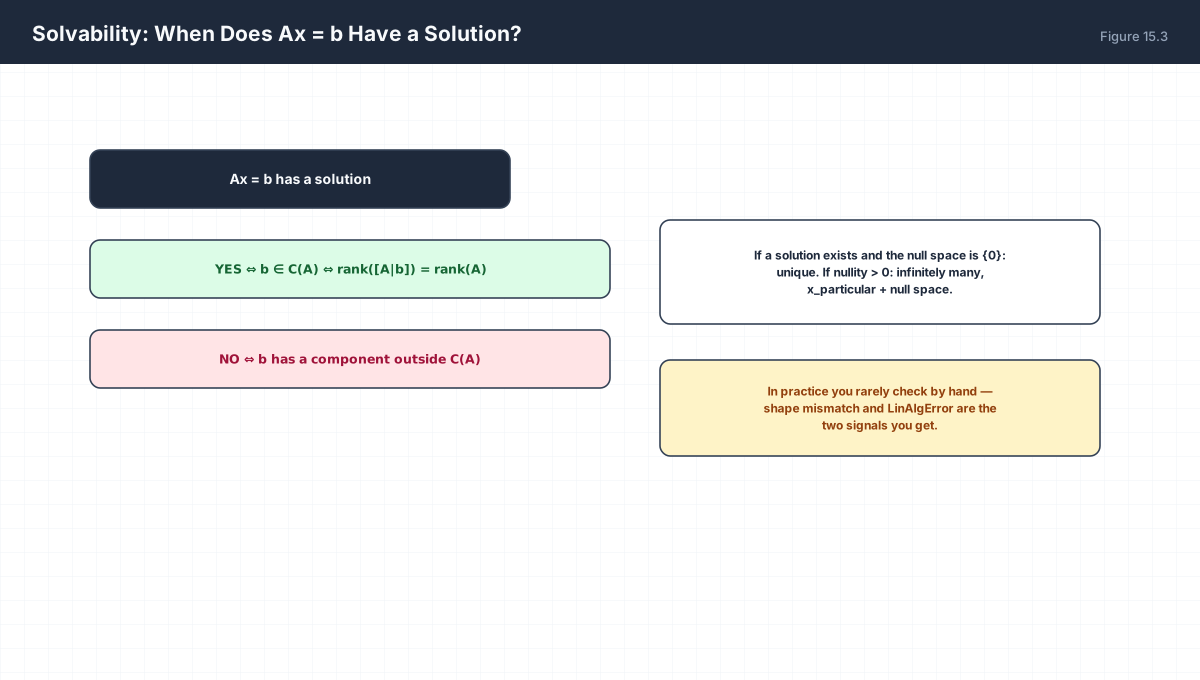
- Decide solvability from
rank(A)versusrank([A|b]). - Predict what a rank-deficient layer destroys.
- Detect rank collapse in a trained network.
2. The Four Subspaces
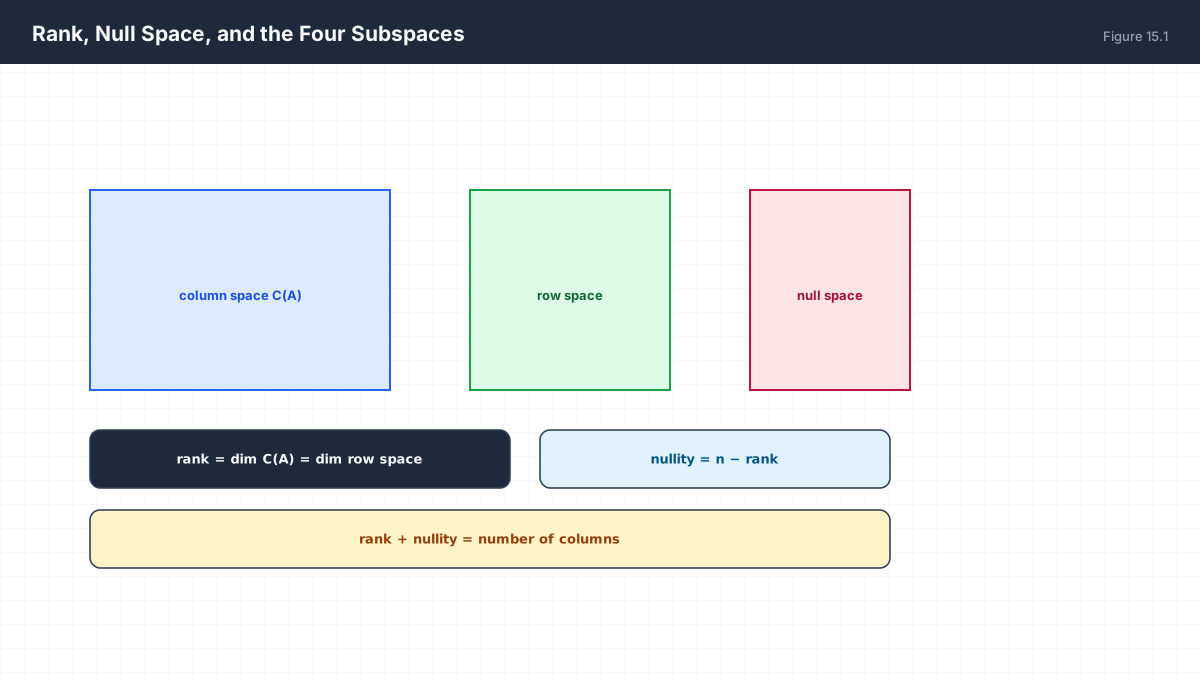
For A ∈ ℝ^(m×n):

column space  C(A) ⊆ ℝ^m     dim = rank
row space     C(Aᵀ) ⊆ ℝ^n    dim = rank
null space    N(A) ⊆ ℝ^n     dim = n − rank
left null     N(Aᵀ) ⊆ ℝ^m    dim = m − rank

Rank–nullity:  rank + nullity = n        (number of columns)
import numpy as np

A = np.array([[1.0, 2.0, 3.0],
              [2.0, 4.0, 6.0],
              [1.0, 1.0, 1.0]])

r = np.linalg.matrix_rank(A)
print("shape:", A.shape, " rank:", r, " nullity:", A.shape[1] - r)
assert r + (A.shape[1] - r) == A.shape[1]

# the null space comes from the smallest right singular vectors
u, s, vt = np.linalg.svd(A)
n = vt[r:].T
print("null space basis:\n", np.round(n, 6))
print("A @ null == 0:", np.allclose(A @ n, 0.0, atol=1e-12))
The last two lines are the practical definition. Any vector v with ‖Av‖ ≈ 0 is in (or nearly in) the null space, and the SVD hands you an orthonormal basis for it as the trailing rows of Vᵀ.
3. The Null Space Is What the Matrix Erases
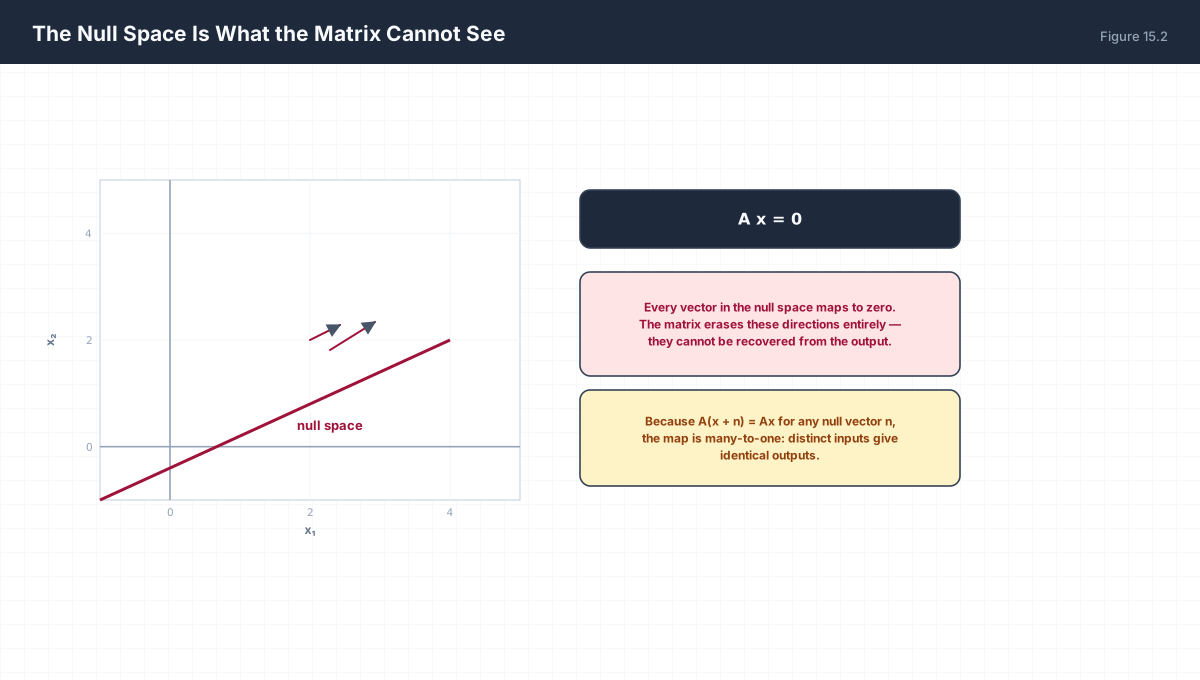
The consequence is many-to-one behaviour. If An = 0, then for any input x:
A(x + n) = Ax + An = Ax + 0 = Ax

Two distinct inputs, one identical output.
The map cannot be inverted: given Ax you cannot tell
whether the input was x or x + n.
import numpy as np

A = np.array([[1.0, 2.0],
              [2.0, 4.0]])
n = np.array([2.0, -1.0])              # null vector: row2 = 2*row1
print("A @ n =", A @ n)                # [0. 0.]

x = np.array([3.0, 1.0])
print("A x       =", A @ x)
print("A (x + n) =", A @ (x + n))
assert np.allclose(A @ x, A @ (x + n))
print("two different inputs, identical output")
4. Solvability: The Decision Table
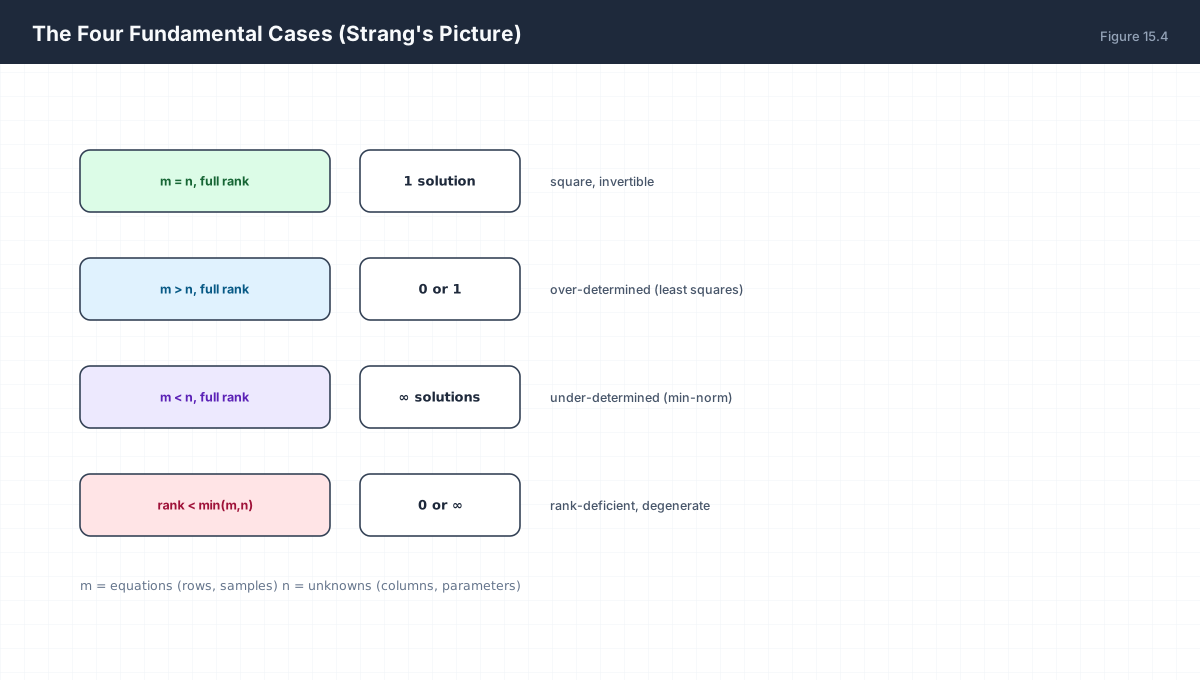
| Case | Solutions | Use |
|---|---|---|
m = n, full rank |
Exactly one | np.linalg.solve |
m > n, full column rank |
Zero or one | lstsq — least squares |
m < n, full row rank |
Infinitely many | lstsq — minimum norm |
rank < min(m,n) |
Zero or infinitely many | lstsq, or add ridge |
import numpy as np

# over-determined: 4 equations, 2 unknowns
X = np.array([[1.0, 0.0], [0.0, 1.0], [1.0, 1.0], [2.0, 1.0]])
y = np.array([1.0, 2.0, 3.0, 4.5])

print("rank(X):", np.linalg.matrix_rank(X), "of", X.shape[1], "columns")
w, *_ = np.linalg.lstsq(X, y, rcond=None)
resid = np.linalg.norm(X @ w - y)
print("least-squares residual:", round(resid, 4))    # not zero: no exact solution
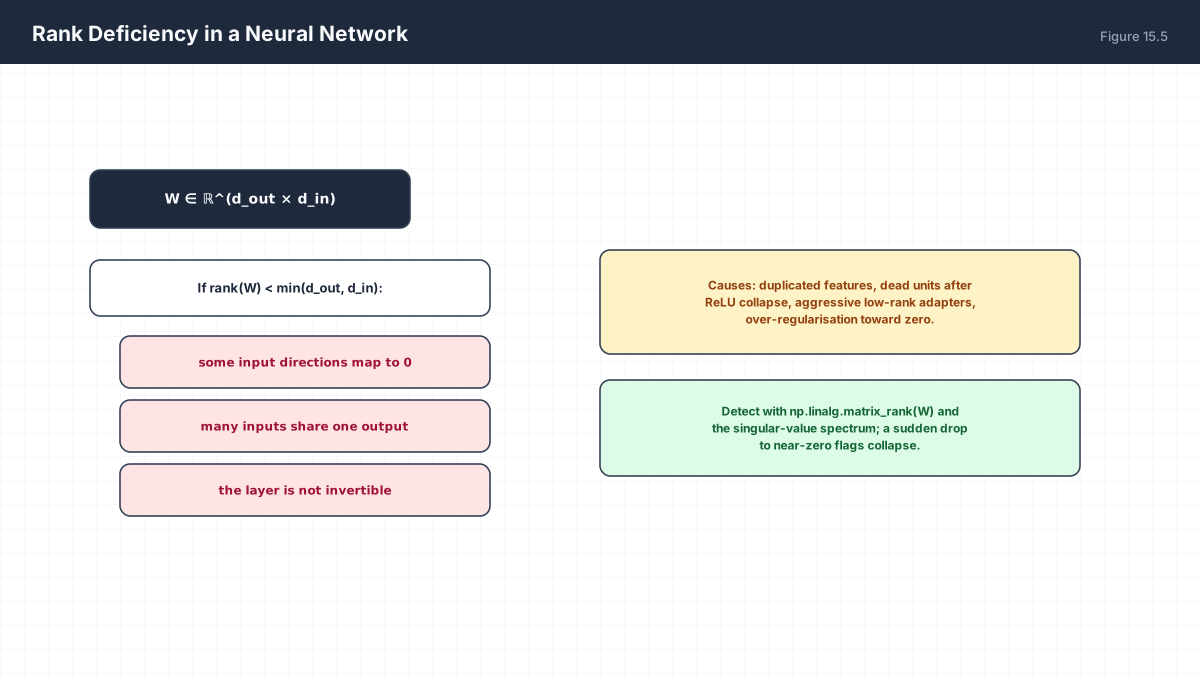
5. Rank Deficiency in a Network
import numpy as np

rng = np.random.default_rng(0)
d = 64

healthy = rng.normal(size=(d, d)) / np.sqrt(d)
print("healthy rank:", np.linalg.matrix_rank(healthy))

# simulate collapse: 40 of 64 rows driven to zero (dead units)
collapsed = rng.normal(size=(d, d)) / np.sqrt(d)
collapsed[:40] = 0.0
print("collapsed rank:", np.linalg.matrix_rank(collapsed))    # 24, not 64

s_h = np.linalg.svd(healthy, compute_uv=False)
s_c = np.linalg.svd(collapsed, compute_uv=False)
print("healthy  smin/smax:", f"{s_h[-1]/s_h[0]:.4f}")
print("collapsed smin/smax:", f"{s_c[-1]/s_c[0]:.2e}")
The ratio σmin/σmax is the reciprocal condition number, and it is the practical collapse detector. A value falling by many orders of magnitude during training means the layer is progressively ignoring input directions — which is what “dead units” look like in matrix form.
6. Worked Examples
6.1 Rank from inspection
A = [[1,2],[2,4]]
row₂ = 2·row₁  →  rank 1
nullity = 2 − 1 = 1
null vector (2,−1) since 1·2 + 2·(−1) = 0
6.2 Rank of a rank-one outer product
u vᵀ for u ∈ ℝ^m, v ∈ ℝⁿ has rank exactly 1.
Every column is a multiple of u.
6.3 Inconsistent system
x + y = 1
x + y = 2
rank([[1,1],[1,1]]) = 1
rank([[1,1,1],[1,1,2]]) = 2
Extended rank exceeds coefficient rank → no solution.
6.4 Under-determined system
x + y = 3      (1 equation, 2 unknowns)
rank = 1, nullity = 1, infinitely many solutions
Solver returns the minimum-norm one: (1.5, 1.5).
6.5 Rank bound of a product
rank(AB) ≤ min(rank A, rank B)
So a rank-4 LoRA adapter ΔW = BA is at most rank 4,
no matter how large A and B are.
7. Verify It in Python
import numpy as np

# --- 1. rank-nullity identity -------------------------------------
A = np.array([[1., 2., 3.], [2., 4., 6.], [1., 1., 1.]])
r = np.linalg.matrix_rank(A)
assert r + (A.shape[1] - r) == A.shape[1]
print("rank:", r, " nullity:", A.shape[1] - r)

# --- 2. null space from SVD ---------------------------------------
u, s, vt = np.linalg.svd(A)
null = vt[r:].T
assert np.allclose(A @ null, 0.0, atol=1e-12)
print("null basis has", null.shape[1], "vector(s)")

# --- 3. many-to-one mapping ---------------------------------------
D = np.array([[1., 2.], [2., 4.]])
n = np.array([2., -1.])
assert np.allclose(D @ n, 0.0)
x = np.array([3., 1.])
assert np.allclose(D @ x, D @ (x + n))
print("null vector causes identical outputs")

# --- 4. inconsistent system detection -----------------------------
M = np.array([[1., 1.], [1., 1.]])
b = np.array([1., 2.])
aug = np.column_stack([M, b])
assert np.linalg.matrix_rank(M) < np.linalg.matrix_rank(aug)
print("rank(A):", np.linalg.matrix_rank(M),
      " rank([A|b]):", np.linalg.matrix_rank(aug), "-> inconsistent")

# --- 5. under-determined returns minimum norm ---------------------
row = np.array([[1., 1.]])
sol, *_ = np.linalg.lstsq(row, np.array([3.]), rcond=None)
print("min-norm solution:", sol)
assert np.allclose(sol, [1.5, 1.5])
assert np.isclose(sol @ sol, 4.5)                 # 1.5^2 + 1.5^2

# --- 6. rank of an outer product is 1 -----------------------------
u = np.arange(1., 5.); v = np.array([2., 3., 5.])
assert np.linalg.matrix_rank(np.outer(u, v)) == 1
print("outer product rank:", np.linalg.matrix_rank(np.outer(u, v)))

# --- 7. rank of a product is bounded -------------------------------
rng = np.random.default_rng(0)
Bmat = rng.normal(size=(64, 4))
Amat = rng.normal(size=(4, 64))
dW = Bmat @ Amat
assert np.linalg.matrix_rank(dW) <= 4
print("rank(BA) <= 4:", np.linalg.matrix_rank(dW))

# --- 8. collapse detector -----------------------------------------
W = rng.normal(size=(32, 32)) / np.sqrt(32)
sv = np.linalg.svd(W, compute_uv=False)
ratio = sv[-1] / sv[0]
print("sigma_min/sigma_max:", f"{ratio:.4f}")
assert ratio > 1e-6                                # healthy: not collapsed
print("all assertions passed")
8. Practice Questions
- Find the rank and nullity of
[[1,2,3],[2,4,6]]. - Give a null vector for
[[1,2],[2,4]]and verifyAv = 0. - State the rank–nullity theorem and apply it to a
(3×5)full-rank matrix. - When is
Ax = binconsistent, in terms of ranks? - Show that a rank-one outer product has rank exactly one.
- Prove
rank(AB) ≤ min(rank A, rank B)and give an example where it is strictly smaller. - Explain why a rank-deficient layer cannot be inverted.
- What does
σmin/σmaxapproaching zero indicate during training? - Why does
lstsqsucceed wheresolveraisesLinAlgError? - For a LoRA adapter with
r = 8on a4096×4096weight, what is the maximum rank of the update?
9. Official References & Further Reading
Continue the Course
- Course Index: AI Mathematics Masterclass — All 48 Chapters
- Previous Chapter: Chapter 14: Singular Value Decomposition (SVD)
- Next Chapter: Chapter 16: Tensors, Axes & Broadcasting Mathematics
- Related Series: PyTorch Engineering Masterclass — All 16 Modules