
AI Reading
Quick summary of this article
AI Mathematics Masterclass — Chapter 48 of 48
This chapter assembles everything into one system. We trace a token from integer to prediction through every mathematical object the course has built, account for where the parameters and FLOPs actually go, budget the memory a training run needs, and collect the handful of formulas worth carrying around. Nothing here is new — the point is that it now fits together.
1. Technical Audit & Core Learning Objectives
| Component | Common Tutorial Deficiency | Engineering Standard Applied Here |
|---|---|---|
| Assembly | Chapters never composed into one object. | A token traced end to end with every operation named. |
| Budgeting | Parameter counts quoted without memory context. | All four training budgets computed for a real config. |
| Verification | No end-to-end check anywhere. | A full forward pass implemented and shape-checked. |
| Retention | 48 chapters with no summary. | The ten numbers worth memorising, derived where used. |
Core learning objectives. After this chapter you should be able to:
- Trace a token through a complete transformer.
- Account for parameters by component.
- Compute the four training memory budgets.
- Estimate training FLOPs and wall-clock time.
- Identify which chapter each practical failure traces back to.
- Reproduce the core formulas from memory.
2. One Block, End to End
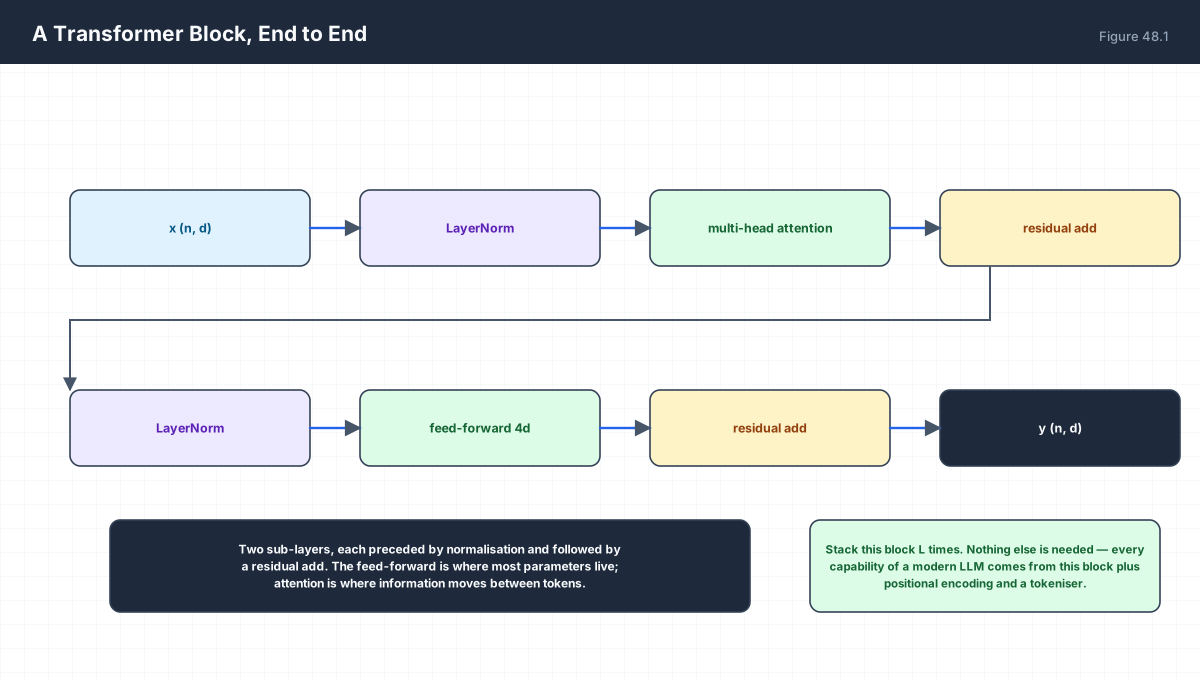
id            -> integer from the tokeniser
x  = E[id]                            (d,)        ch 46
x  = x + pos                          (d,)        ch 40

for each of L layers:
    h = LayerNorm(x)                  (d,)        ch 43
    a = MultiHeadAttention(h)         (d,)        ch 41, 42
    x = x + a                         residual    ch 37
    h = LayerNorm(x)
    f = W2 relu(W1 h)                 (4d)        ch 37, 38
    x = x + f

logits = x W_out                      (V,)        ch 46
p      = softmax(logits / T)          (V,)        ch 35, 38
loss   = -log p[target]                           ch 35, 44
import numpy as np

rng = np.random.default_rng(0)

def layer_norm(x, eps=1e-5):
    mu, var = x.mean(-1, keepdims=True), x.var(-1, keepdims=True)
    return (x - mu) / np.sqrt(var + eps)

def softmax(z):
    z = z - z.max(axis=-1, keepdims=True)
    e = np.exp(z)
    return e / e.sum(axis=-1, keepdims=True)

def attention(X, Wq, Wk, Wv, causal=True):
    n, d = X.shape
    Q, K, V = X @ Wq, X @ Wk, X @ Wv
    S = Q @ K.T / np.sqrt(d)
    if causal:
        S = S + np.triu(np.full((n, n), -np.inf), k=1)
    return softmax(S) @ V

def block(X, P):
    h = layer_norm(X)
    X = X + attention(h, P["Wq"], P["Wk"], P["Wv"])
    h = layer_norm(X)
    ff = np.maximum(h @ P["W1"], 0.0) @ P["W2"]
    return X + ff

n, d, V, L = 5, 16, 40, 3
P = {}
for k in ("Wq", "Wk", "Wv", "W1", "W2"):
    P[k] = rng.normal(size=(d, d)) / np.sqrt(d)
P["W1"] = rng.normal(size=(d, 4 * d)) / np.sqrt(d)
P["W2"] = rng.normal(size=(4 * d, d)) / np.sqrt(4 * d)
E = rng.normal(size=(V, d)) * 0.1
W_out = rng.normal(size=(d, V)) / np.sqrt(d)

ids = np.array([3, 11, 7, 2, 19])
X = E[ids]
for _ in range(L):
    X = block(X, P)

logits = X @ W_out
probs = softmax(logits)
print("input ids     :", ids)
print("embedding     :", E[ids].shape)
print("after blocks  :", X.shape)
print("logits        :", logits.shape)
print("probs row sums:", np.round(probs.sum(axis=1), 12))
print("argmax per pos:", probs.argmax(axis=1))
Every shape is preserved through the block — (n, d) in, (n, d) out — which is what allows the stack to be repeated L times. The only shape changes are at the embedding (integer to vector), inside the feed-forward (d to 4d and back), and at the output projection (d to V).
3. Where the Parameters Go
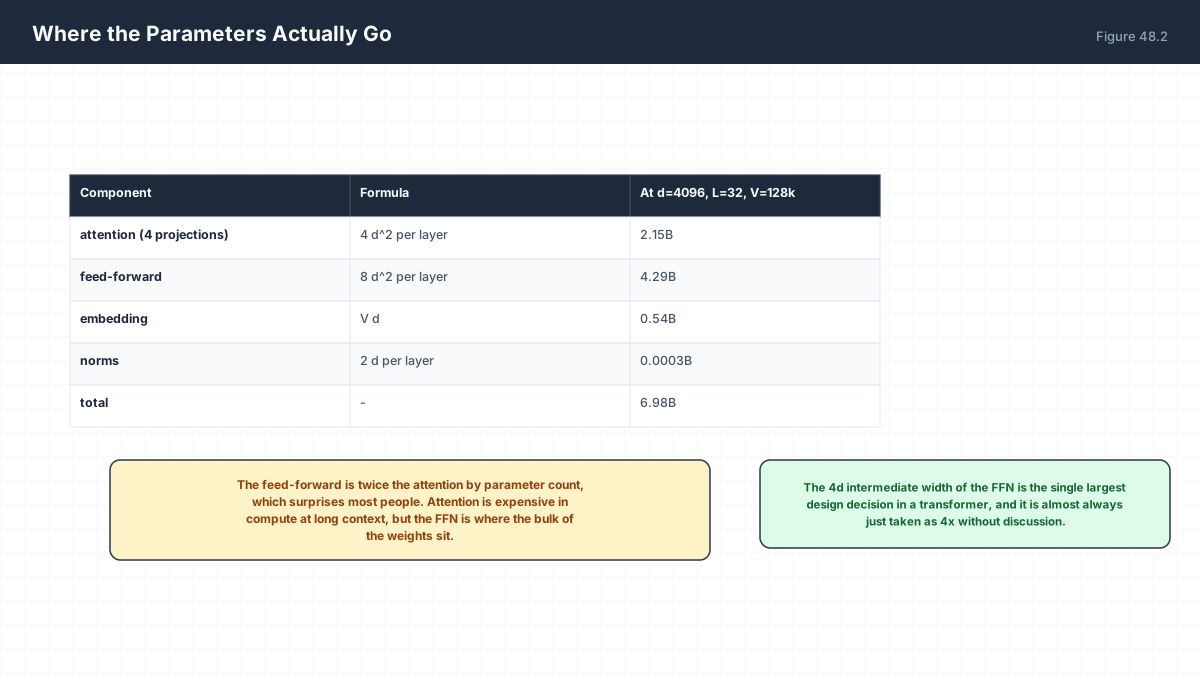
Per layer, with model width d:

  attention   Wq, Wk, Wv, W_O   4 d^2
  feed-forward W1 (d x 4d)      4 d^2
               W2 (4d x d)      4 d^2
                                -----
  total per layer               12 d^2
  plus two norms                4 d

Total = 12 L d^2  +  V d          (embedding, if untied)
def budget(d, L, V, tie=True):
    attn = 4 * d * d
    ff = 8 * d * d
    norms = 4 * d
    body = L * (attn + ff + norms)
    emb = V * d
    head = 0 if tie else V * d
    return dict(attn=L * attn, ff=L * ff, norms=L * norms, emb=emb, head=head,
                total=body + emb + head)

for name, d, L, V in [("small", 768, 12, 50_257),
                      ("7B-class", 4096, 32, 128_000),
                      ("large", 8192, 80, 128_000)]:
    b = budget(d, L, V)
    print(f"{name:10s} d={d:5d} L={L:3d}")
    print(f"  attention {b['attn']/1e9:8.2f}B   feed-forward {b['ff']/1e9:8.2f}B")
    print(f"  embedding {b['emb']/1e9:8.2f}B   norms        {b['norms']/1e9:8.3f}B")
    print(f"  total     {b['total']/1e9:8.2f}B")
    print(f"  ff share of body: {b['ff']/(b['attn']+b['ff']):.1%}")
    print()

# what 12 L d^2 predicts
d, L = 4096, 32
print(f"12 L d^2 = {12*L*d*d/1e9:.2f}B (body only, excludes norms and embedding)")
The feed-forward is always exactly twice the attention by parameter count, because 8d² against 4d². Attention dominates compute at long context but the feed-forward dominates capacity at every context.
4. The Four Memory Budgets
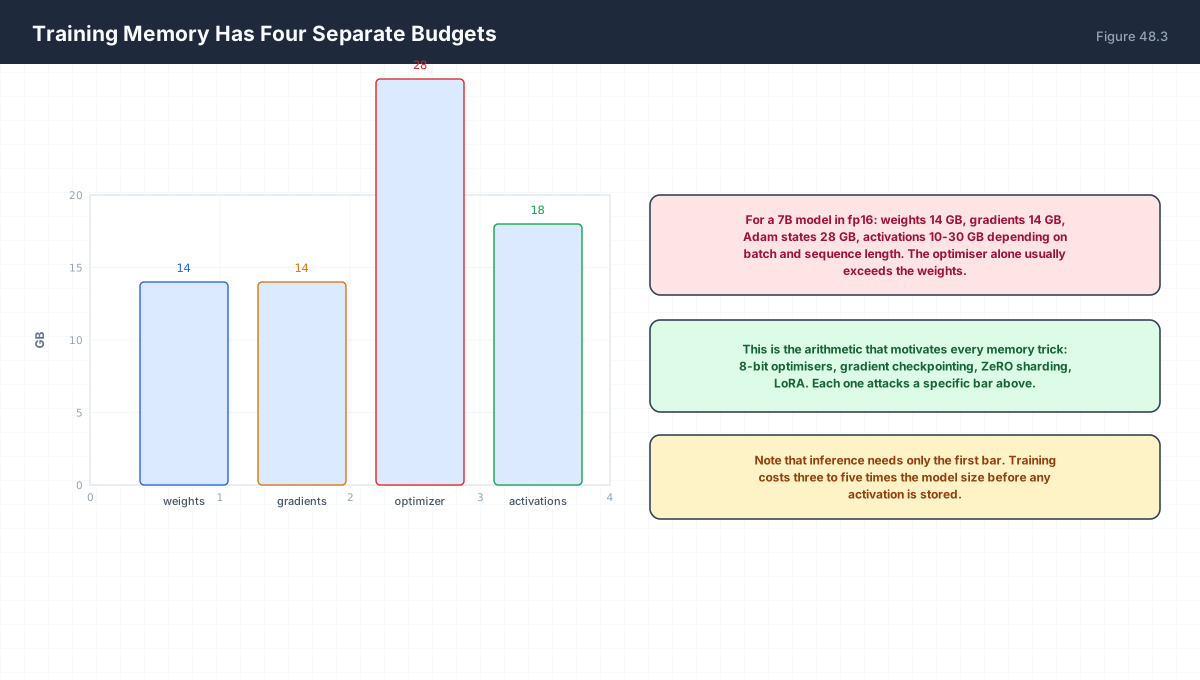
Training a model with N parameters:

  weights          N * bpe
  gradients        N * bpe          (one per parameter)
  optimiser        N * 2 * 4        (Adam: m and v, in fp32)
  activations      n * d * L * b * bpe * k

The last term has a constant k of order 10, because every
layer stores several tensors for the backward pass.

Inference needs only the first term plus the KV cache.
def mem_gb(n_params, bpe=2, optimiser_bytes=8):
    return (n_params * bpe * 2 + n_params * optimiser_bytes) / 1e9

def act_gb(n, d, L, batch, bpe=2, k=10):
    return n * d * L * batch * bpe * k / 1e9

N = 7e9
print(f"7B model, bf16 weights + Adam:")
print(f"  weights + grads : {N*2*2/1e9:8.2f} GB")
print(f"  optimiser       : {N*8/1e9:8.2f} GB")
print(f"  subtotal        : {mem_gb(N):8.2f} GB")
for n, batch in [(2048, 8), (8192, 8), (8192, 32)]:
    a = act_gb(n, 4096, 32, batch)
    print(f"  activations n={n:5d} b={batch:2d}: {a:7.2f} GB  -> total {mem_gb(N)+a:7.2f} GB")

print()
print("Every trick targets one line:")
print("  ZeRO / FSDP        shard weights, grads and optimiser across devices")
print("  gradient checkpointing   store fewer activations, recompute on backward")
print("  LoRA                freeze weights and train a low-rank update")
print("  8-bit optimiser     cut the largest single line")
At 8k context with batch 32 the activation term is 215 GB on its own. This is not a tuning problem — it is why sharding and checkpointing are mandatory rather than optional above a certain size.
5. Cost and Time
Training:   6 N D FLOPs                     ch 46
Inference:  2 N FLOPs per generated token    ch 46

Time = FLOPs / (throughput * utilisation)

Utilisation is the honest part. A 400 TFLOP/s card running a
transformer at 40% efficiency delivers 160 TFLOP/s, and the
planning estimate is wrong by 2.5x if you forget it.
def wall_time(flops, tflops_peak=400.0, utilisation=0.4):
    eff = tflops_peak * utilisation * 1e12
    seconds = flops / eff
    return seconds, seconds / 86400

for label, N, D in [("1.5B / 300B tokens", 1.5e9, 3e11),
                    ("7B / 2T tokens", 7e9, 2e12),
                    ("70B / 2T tokens", 70e9, 2e12)]:
    f = 6 * N * D
    s, days = wall_time(f)
    print(f"{label:22s} {f:8.2e} FLOPs  {days:9.1f} GPU-days  "
          f"({days/30:6.2f} months on 1 GPU, {days/1024/30:.2f} months on 1024)")

print()
print("inference cost per 1M generated tokens for the 7B model:")
per_tok = 2 * 7e9
print(f"  {per_tok*1e6/1e15:.3f} PFLOP total — small, but it recurs forever")
The training run is a one-off; inference is not. For a model serving millions of users the cumulative inference cost overtakes training within weeks, which is why 6ND is a planning formula for researchers and 2N is the number that matters commercially.
6. The Numbers Worth Carrying
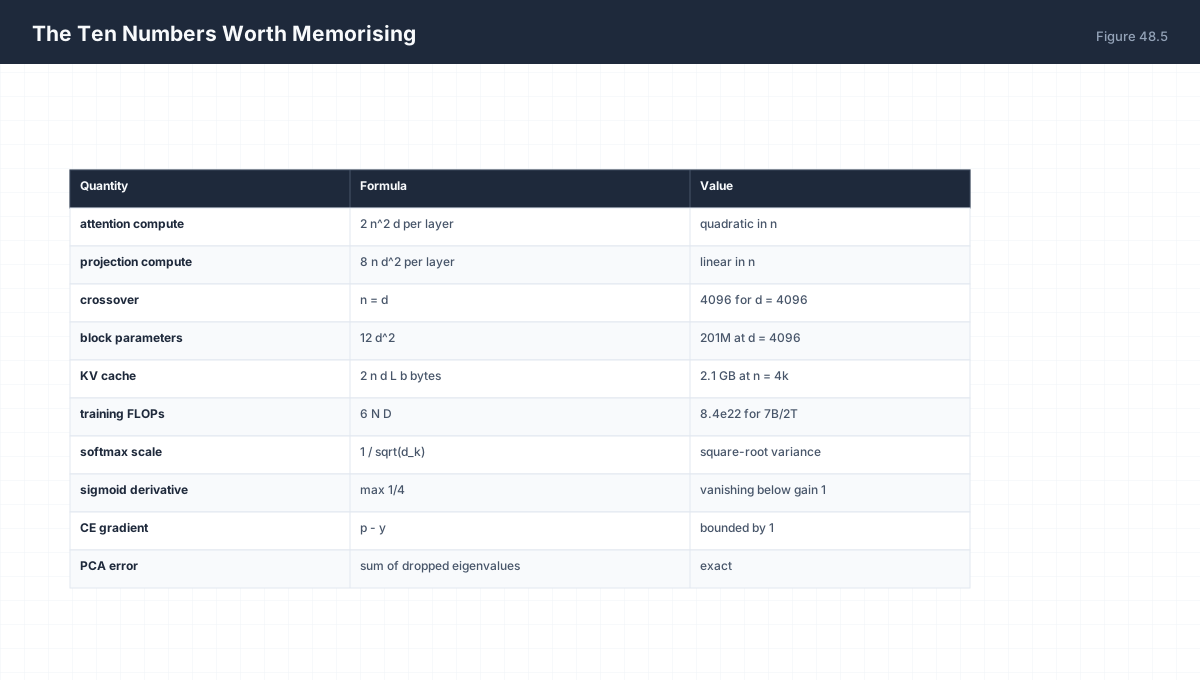
| Result | Chapter |
|---|---|
| Attention compute is 2n²d per layer; projections 8nd² | 41, 42 |
| A transformer block is 12d² parameters | 48 |
| Softmax-plus-cross-entropy gradient is p − y | 35, 38 |
| Sigmoid’s derivative is bounded by ¼ | 38 |
| PCA error equals the sum of discarded eigenvalues | 36 |
| Cross-entropy = entropy + KL divergence | 35 |
| L1 zeroes, L2 shrinks — because their gradients differ in kind | 34 |
| Output size of a convolution: (n + 2p − d(k−1) − 1)/s + 1 | 39 |
| RoPE makes the attention score depend only on m − n | 40 |
| Training FLOPs ≈ 6ND | 46 |
7. Tracing a Failure Back
| Symptom | Where to look |
|---|---|
| Loss becomes NaN after a few hundred steps | Numerical stability — log of zero, exp overflow (ch 47) |
| Trains but generalises badly | Bias–variance, regularisation (ch 34) |
| Deep network will not train from a good initialisation | Vanishing gradient, activation choice (ch 38) |
| Cannot tell word order | Missing positional encoding (ch 40) |
| Attention maps all look identical | Head collapse (ch 42) |
| Outputs depend on batch composition | BatchNorm in eval mode (ch 43) |
| Loss plateaus at a high value that looks like noise | Class imbalance or the wrong loss (ch 44) |
| Out of memory on a model that should fit | Optimiser state and activations (ch 48) |
| Model confidently wrong, and slow to correct | Saturation and loss choice (ch 38, 44) |
8. Verify It in Python
import numpy as np

rng = np.random.default_rng(0)
relu = lambda z: np.maximum(z, 0.0)

def layer_norm(x, eps=1e-5):
    mu, var = x.mean(-1, keepdims=True), x.var(-1, keepdims=True)
    return (x - mu) / np.sqrt(var + eps)

def softmax(z):
    z = z - z.max(axis=-1, keepdims=True)
    e = np.exp(z)
    return e / e.sum(axis=-1, keepdims=True)

def attn(X, Wq, Wk, Wv, causal=True):
    n = X.shape[0]
    Q, K, V = X @ Wq, X @ Wk, X @ Wv
    S = Q @ K.T / np.sqrt(X.shape[1])
    if causal:
        S = S + np.triu(np.full((n, n), -np.inf), 1)
    return softmax(S) @ V

def block(X, P):
    X = X + attn(layer_norm(X), P["Wq"], P["Wk"], P["Wv"])
    h = layer_norm(X)
    return X + relu(h @ P["W1"]) @ P["W2"]

# --- 1. full forward pass --------------------------------
n, d, V, L = 4, 8, 20, 2
P = {"Wq": rng.normal(size=(d, d)), "Wk": rng.normal(size=(d, d)),
     "Wv": rng.normal(size=(d, d)), "W1": rng.normal(size=(d, 4*d)),
     "W2": rng.normal(size=(4*d, d))}
E = rng.normal(size=(V, d)) * 0.1
W_out = rng.normal(size=(d, V))

ids = np.array([1, 4, 2, 9])
X = E[ids]
for _ in range(L):
    X = block(X, P)
probs = softmax(X @ W_out)
assert probs.shape == (n, V)
assert np.allclose(probs.sum(axis=1), 1.0)
print(f"forward pass: ids {ids} -> probs {probs.shape}, rows sum to 1")

# --- 2. the block preserves shape ----------------------
assert X.shape == (n, d)
print(f"block maps {(n,d)} to {X.shape}")

# --- 3. parameter formula 12 L d^2 ---------------------
def body_params(d, L):
    return L * 12 * d * d

assert body_params(4096, 32) == 6_442_450_944
print(f"12 L d^2 at d=4096, L=32: {body_params(4096,32)/1e9:.2f}B")

# --- 4. feed-forward is twice attention ----------------
for width in (256, 768, 4096):          # do not rebind d — it is used below
    assert 8 * width * width == 2 * (4 * width * width)
print("feed-forward is always exactly 2x attention")

# --- 5. causal mask keeps the future out ---------------
A = softmax(np.zeros((4, 4)) + np.triu(np.full((4, 4), -np.inf), 1))
assert np.all(A[np.triu_indices(4, 1)] == 0)
assert np.allclose(A.sum(axis=1), 1)
print("causal mask verified")

# --- 6. change at position i cannot affect position j d -----
d_model = 4096
for n_tok in (1024, 4096, 16384):
    a, p = n_tok ** 2 * d_model, n_tok * d_model ** 2
    assert (a > p) == (n_tok > d_model)
print("attention exceeds projections exactly when n > d")

# --- 10. KV cache doubles when context doubles ---------
kv = lambda n, d, L, bpe=2: 2 * n * d * L * bpe / 1e9
assert np.isclose(kv(8192, 4096, 32), 2 * kv(4096, 4096, 32))
print(f"KV cache at 4k: {kv(4096,4096,32):.2f} GB, at 8k: {kv(8192,4096,32):.2f} GB")
print("all assertions passed")
9. Where to Go Next
- Implement a transformer from scratch with only NumPy, then port it to PyTorch and compare outputs.
- Derive the gradient of a two-layer network by hand and check it against autograd.
- Take a trained small model and measure head entropy, KV cache size and actual FLOPs.
- Re-derive flash attention’s online softmax from the stability argument in Chapter 47.
- Profile a training step and confirm the four memory budgets against reality.
The next course in this series, the PyTorch Engineering Masterclass, takes every formula here and implements it.
10. Official References & Further Reading
Course Complete
- Course Index: AI Mathematics Masterclass — All 48 Chapters
- Previous Chapter: Chapter 47: Numerical Stability, Precision & Underflow Mathematics
- Next Course: PyTorch Engineering Masterclass — All 16 Modules